Medication non-adherence affects roughly 50% of elderly patients with chronic conditions — driving hospitalizations, eroding independence, and straining caregivers. Our client came to M7 with a vision for a wearable that could address all of it in a single device. The opportunity was significant. So was the complexity.
Medical Wearable for Independent Living
The Challenge
One device.
Three problems to solve.
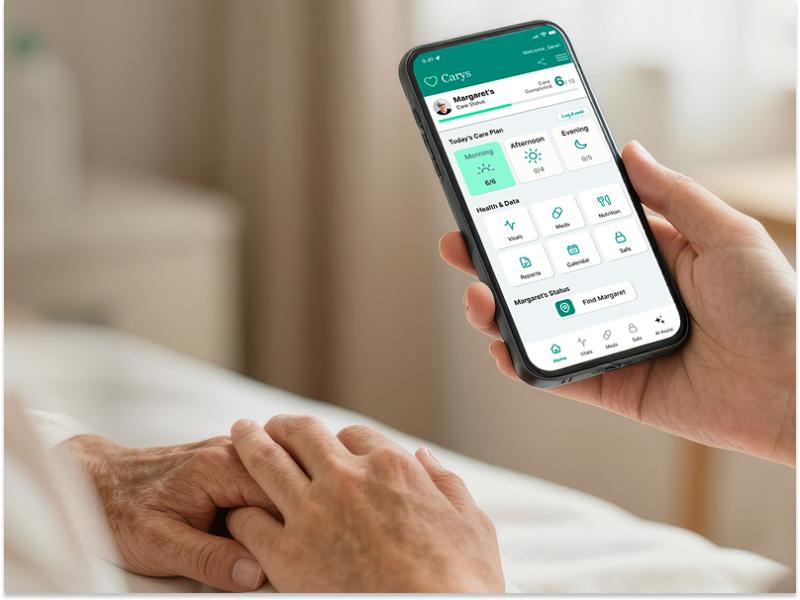
The goal was a single wearable capable of medication reminders, fall detection, and emergency calling — designed specifically for elderly users, and built to support independent living. Every component decision and every interaction had to be made with a non-technical user in mind.
Our Approach
Constraints first.
Design tools second.
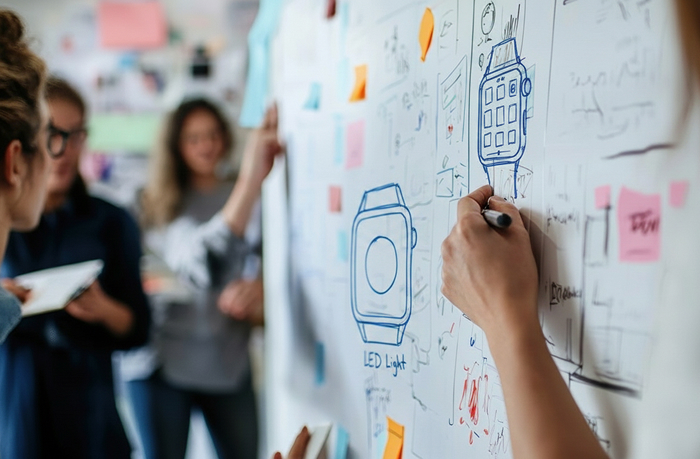
We mapped the real constraints before touching any design tools. Processor selection, wireless connectivity, power envelope, and sensor accuracy all had downstream effects on each other.
We engaged directly with chipset manufacturers and their development partners early — to understand support options and avoid integration surprises downstream. Nothing was specced on assumption.
Hardware Architecture
Every component chosen deliberately.
Sensor selection went through multiple rounds of rigorous comparison across accuracy, power draw, size, availability, and cost. Pressure sensing, wireless charging, and antenna design each got the same treatment.
What Are We Packing Into this Mico Device?
Industrial Design
Compact. Discreet. Clinical-grade.
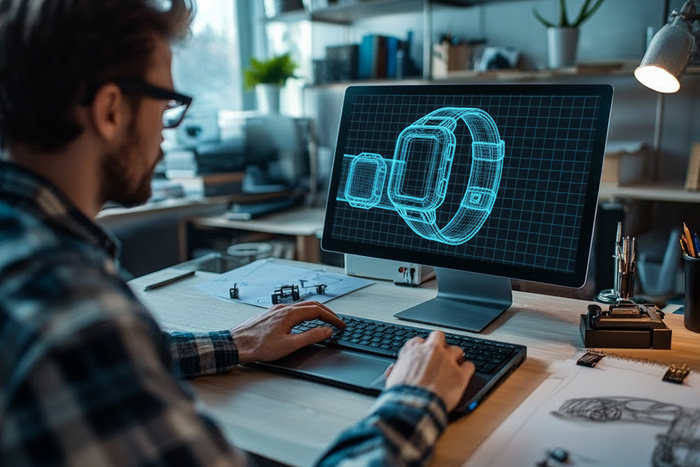
The device body measures just 32–35mm and sits flush on the wrist. No screens. No buttons to misread. A design that disappears into daily life.
UX for Real Users
Simple enough to operate without instruction.
This wasn't a consumer wellness gadget for the tech-savvy. Every interaction was designed with an elderly user in mind — tap-based controls, voice commands, and multimodal feedback ensure the device communicates clearly even when a user can't see a screen or read small text.
Hardware and UX decisions were made in parallel, not sequence. The sensor choices affected the feature set. The form factor affected the interaction model. Holding all of that simultaneously is what made the difference.
The Outcome
Hardware and software as a single discipline.
This engagement succeeded because we refused to treat hardware and software as separate workstreams. The PCB decisions affected the UX. The sensor choices affected the feature set. That integration — the willingness to slow down and get component selection right — is what M7 is built for.